
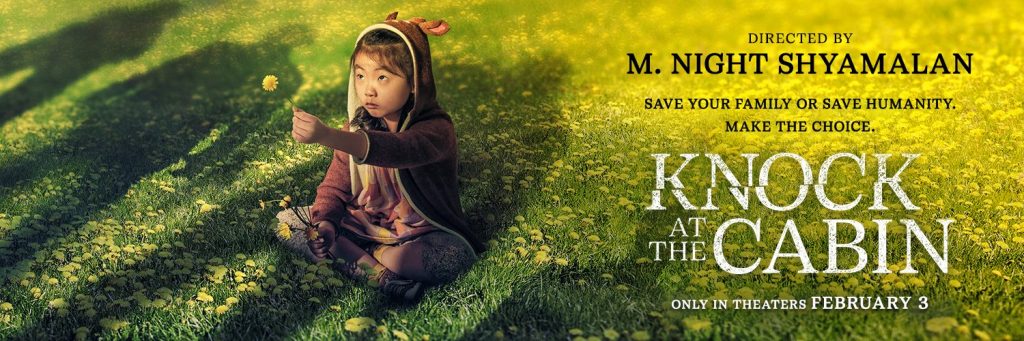
Knock at the Cabin has apocalyptic stakes, but it never behaves like a big-apocalypse movie. That is one of the best things about it.
The premise sounds enormous on paper: a family must choose one of their own to die or the world will end. You could imagine that story getting stretched into something louder, broader, and much more interested in spectacle. Shyamalan does the opposite. He takes the end of the world and stuffs it into a cabin, a few close-ups, a handful of bodies, and a moral question nobody can answer cleanly.
That is why the movie works as well as it does. It is an apocalypse film shaped like a chamber piece.
The setup is huge, but the pressure is intimate
The film page on MNightFans gets the core idea exactly right: the movie traps a family in one location and asks them to respond to a claim so enormous it would sound absurd if it did not also feel terrifying. Are the intruders delusional? Are they right? And what happens to a family once that question starts grinding away at them minute by minute?
That is chamber-piece material. The drama is not built around cities collapsing or governments reacting. It is built around who believes what in this room, right now, and what that belief is doing to the people they love. The apocalypse matters, obviously, but the movie keeps translating it back down to the level of faces, pauses, bargaining, panic, and exhausted disbelief.
It is really a belief thriller
One of the sharpest things Shyamalan said in the Time interview is that the film keeps putting viewers in the position of deciding, over and over, whether to believe the strangers. He compared that structure to a “jury movie,” and that feels exactly right.
You are not just watching characters survive a siege. You are constantly being asked to weigh testimony. Leonard and the others arrive with sincerity, detail, and a horrifying claim. Andrew pushes back hard, and often for very good reasons. Eric is more open, more spiritually porous, and therefore more vulnerable to what he may be seeing. The movie keeps shifting the emotional center of gravity because certainty never gets to settle for long.
That makes the film feel active even when people are sitting still. Every conversation is a vote. Every new sign of possible catastrophe reopens the case.
The cabin does not feel small. It feels sealed.
There is a difference. Small can feel cheap. Sealed feels oppressive.
Shyamalan’s visual approach helps a lot here. In the Collider interview, he talked about using close-ups and natural light to make the film feel more organic. You can feel that immediately in the finished movie. Faces take up space. Rooms feel tighter than they should. The outside world exists, but only in slivers. Even when the story gestures toward global disaster, the movie keeps dragging your attention back to the trapped human bodies who have to decide what any of it means.
That is the chamber-piece trick. The movie does not deny the scale of the premise. It just refuses to let scale become an escape hatch from intimacy.
Dave Bautista is crucial to the whole machine
This movie would wobble badly if Leonard felt like a standard heavy. He cannot. He has to be terrifying and persuasive at the same time.
Bautista gives the role exactly that contradiction. He is physically imposing enough to make the threat immediate, but his sadness and sincerity are what make the film unsettling. If Leonard were smug, theatrical, or obviously lying, the moral pressure would collapse. The story needs him to feel like a man carrying something awful rather than enjoying power over other people.
That choice ripples through the whole ensemble. Nikki Amuka-Bird, Abby Quinn, and Rupert Grint each bring a different texture to the intruder group, so the movie never feels like a single-note invasion story. They are instruments in the same terrible argument, but not interchangeable ones.
The family stays at the center where it belongs
What gives the film its ache is that Eric, Andrew, and Wen are not abstract symbols standing in for “humanity.” They feel like a family with a real shared life. The apocalyptic framework only works because the emotional cost of the choice feels personal first.
That is also why the movie’s changes from book-to-film matter less to me than the emotional shape it lands on. Shyamalan said in the Time piece that stories have to meet two standards for him: the form has to be thrilling, and the center has to be human beings grappling emotionally with something. Knock at the Cabin scores high on both. The hook is brutal. The hurt underneath it is what makes the hook stick.
Why the chamber-piece approach was the right one
If this material had been pushed toward broader chaos, I think it would have become less disturbing, not more. Spectacle can actually give you distance. Knock at the Cabin does not want distance. It wants you cornered in the argument.
That is why the movie lingers. It takes one impossible premise and keeps worrying it from every angle: faith, coercion, love, sacrifice, trauma, suspicion, collective responsibility. But it does all of that without losing the tightness of the room. The world may be at stake, yet the movie never stops feeling like it is about one family being forced to decide what kind of truth they can live with.
That balance is hard to pull off. Knock at the Cabin pulls it off by staying disciplined. It keeps the apocalypse intimate, and in doing that, it makes it hurt more.