
********MAJOR SPOILERS********
The ending of Unbreakable works because it does two things in a row, and both of them hit. First it gives David Dunn the beginning of a heroic identity. Then it poisons that awakening by revealing who Elijah Price really is.
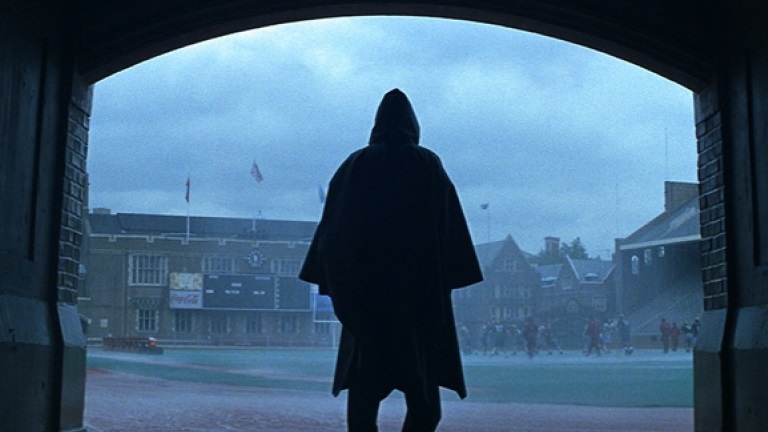
Before the handshake scene, the movie has already crossed a big threshold. David has finally stopped dismissing the evidence in front of him. He has tested himself. He has listened to Elijah enough to consider the possibility that his life has been shaped around strength and purpose he never let himself name. Most importantly, he acts on it.
That is where the security-guard poncho scene comes in. David goes out into the city. Uses his touch. Sees fragments of danger in strangers. Follows the one that leads him to the house where a family is being held captive. He goes in. Quietly. Gets beaten, nearly drowned, keeps going, and saves the children. That scene is the movie’s practical proof of concept. David has moved past theory. He is functioning as a protector.
Then the film narrows down again. David returns to normal space. Home. Family. Joseph’s faith in his father swelling. The newspaper image. The sketch of the rescue. All of that starts giving David’s life a new outline. But Shyamalan is not done.
David goes to see Elijah at the gallery. And this scene is played perfectly. Elijah is calm. Proud. Vulnerable. Almost tender. He looks like the man who finally got to see his theory confirmed. Then they shake hands.
That touch opens the floodgate. David sees disaster after disaster. The train wreck. The hotel fire. The plane crash. Catastrophes we assumed were background evidence in Elijah’s search suddenly become crimes Elijah himself caused. He was manufacturing mass death to prove the opposite had to exist.
That is where the ending stops being melancholy and becomes genuinely chilling. Elijah needed the world to have meaning. Needed his suffering to fit a pattern. Needed his fragility to imply a counterpart. And he needed it so badly that he was willing to kill innocent people to force that pattern to reveal itself. He is a zealot of comic-book logic. A murderer in search of mythic symmetry.
Then comes the line. “They called me Mr. Glass.” It is one of Shyamalan’s most famous button lines because it lands like self-coronation. Elijah has named himself. Not as a hero. Not even as a misunderstood visionary. As the villain he always needed to be in order for David to become what he is becoming.
The text card that follows tells us David reported Elijah and Elijah was committed to an institution. But honestly, the movie has already finished its emotional work by then. The real ending is the double revelation: David accepts that he is a protector, and then learns that the man who led him there built the path out of slaughter.
So the plain sequence goes like this: David begins acting on his abilities, rescues a family from the house, goes to see Elijah, touches him, sees the crimes, hears Elijah name himself Mr. Glass, and understands that his own awakening has been orchestrated by a man willing to create disaster to prove a theory. Hero born. Villain revealed. Both at once.